| 产品介绍 |
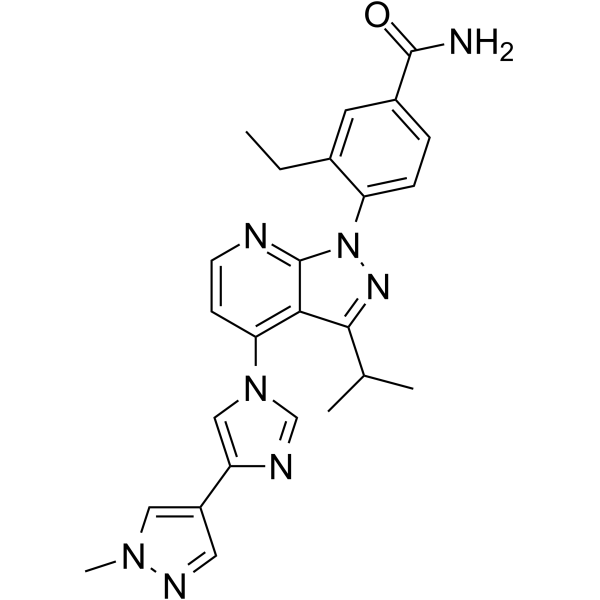
Pimitespib (TAS-116) 是口服生物可利用的,ATP 竞争性的,高特异性的 HSP90α/HSP90β 抑制剂,Ki 值分别为 34.7 nM 和 21.3 nM。不抑制其他 HSP90 家族蛋白如 GRP94。Pimitespib 具有较低的眼部毒性。
|
|---|
| 生物活性 |
Pimitespib (TAS-116) is an oral bioavailable, ATP-competitive, highly specific HSP90α/HSP90β inhibitor (Kis of 34.7 nM and 21.3 nM, respectively) without inhibiting other HSP90 family proteins such as GRP94. Pimitespib demonstrates less ocular toxicity.
|
|---|
| 体外研究 |
Pimitespib binds not only to the conventional-binding pockets as existing Hsp-90 inhibitors, but also to a novel-binding pocket. Such a unique binding mode makes Pimitespib highly specific for Hsp-90α/β without inhibiting other Hsp-90 family proteins such as GRP94 in endoplasmic reticulum or TRAP-1 in mitochondria.
Pimitespib (0-5 μM, 48 hours) inhibits human retinal pigment epithelial ARPE-19 cell lines and NCI-H929 MM cells growth.
More significant degradation of p-C-Raf and p-MEK1/2, HSP90 client proteins and key RAS/RAF/MEK pathway regulators, is triggered by Pimitespib (0.125-1 μM, 24 hours) than 17-AAG in INA6 and NCI-H929 MM cells.
西域 has not independently confirmed the accuracy of these methods. They are for reference only.
Cell Viability Assay
| Cell Line: |
Human retinal pigment epithelial ARPE-19 cell lines and NCI-H929 MM cells |
| Concentration: |
0-5 μM |
| Incubation Time: |
48 hours |
| Result: |
Inhibited NCI-H929 MM cells growth with an IC50 of 0.35 μM. |
Western Blot Analysis
| Cell Line: |
MM cell lines INA6 and NCI-H929 cells |
| Concentration: |
0.125-1 μM |
| Incubation Time: |
24 hours |
| Result: |
Targeted potently HSP90 client proteins including C-Raf and MEK1/2; as well as inhibited upregulation of HSP27 and overcomes 17-AAG resistance mechanisms. |
|
体内研究 (In Vivo) |
Pimitespib (12.0 mg/kg, p.o., 14 days) shows antitumor activity without inducing eye injury in rats. Pimitespib is distributed less in retina than in plasma in rats; consequently, Pimitespib does not produce any detectable photoreceptor injury. Pimitespib triggers enhanced in vivo anti-MM activities, both alone and in combination with PS-341 (BTZ), with a favorable safety profile. Mice treated with Pimitespib (10 mg/kg and 15 mg/kg, orally, 38 days), BTZ, or Pimitespib plus BTZ show significantly enhance growth inhibition versus the vehicle control group. Median overall survival of treated animals (Pimitespib, orally, 10 mg/kg=33 days, 15 mg/kg=37 days, BTZ=36 days, and the combination=56.5 days) is significantly longer than vehicle control.
The favorable pharmacokinetic profile of Pimitespib is reflected in its dose-dependent antitumor activity; the T/C (tumor volume of Pimitespib-treated mice vs. vehicle-treated mice) is 47%, 21%, and 9% for doses of 3.6 mg/kg, 7.1 mg/kg, and 14.0 mg/kg, respectively. Pimitespib is orally absorbed and has a bioavailability of almost 100% in mice, and 69.0% in rats. Pimitespib has moderate terminal elimination half-life (t1/2=8.2 h, 2.5 h, 4.4 h and 2.2 h for mouse (3.6 mg/kg, p.o.), mouse (7.1 mg/kg, p.o.), mouse (14.0 mg/kg, p.o.), rat (4 mg/kg, p.o.)). Pimitespib is more rapidly eliminated from retina (t1/2=3.4 hours) than the other HSP90 inhibitors (t1/2=7.1-19.1 hours).
西域 has not independently confirmed the accuracy of these methods. They are for reference only.
| Animal Model: |
Male F344 nude rats (6 weeks old) with established NCI-H1975 xenografts (6 weeks old) |
| Dosage: |
12.0 mg/kg |
| Administration: |
Oral administration; daily; two weeks |
| Result: |
Led to tumor shrinkage. Showed antitumor activity without inducing eye injury in rats and did not cause ocular toxicity at the effective dose in the NCI-H1975 rat xenograft model. |
| Animal Model: |
CB17 SCID mice (48-54 days old) with murine xenograft model
|
| Dosage: |
10 and 15 mg/kg |
| Administration: |
Oral administration; 5 days a week; for 28 days |
| Result: |
Enhanced significantly growth inhibition versus the vehicle control group. The delay in tumor growth was greater in the combination-treated group compared with either monotherapy cohort.
|
| Animal Model: |
Mice, Rats, and Dogs
|
| Dosage: |
3.0 mg/kg for dogs, 4.0 mg/kg for rats, 3.6, 7.1 and 14.0 mg/kg for mice |
| Administration: |
Oral administration; daily; 20 days |
| Result: |
Absorbed orally and had a bioavailability of almost 100% in mice, 69.0% in rats, and 73.9% in dogs without special formulation.
|
|
| 体内研究 |
Pimitespib (12.0 mg/kg, p.o., 14 days) shows antitumor activity without inducing eye injury in rats. Pimitespib is distributed less in retina than in plasma in rats; consequently, Pimitespib does not produce any detectable photoreceptor injury. Pimitespib triggers enhanced in vivo anti-MM activities, both alone and in combination with PS-341 (BTZ), with a favorable safety profile. Mice treated with Pimitespib (10 mg/kg and 15 mg/kg, orally, 38 days), BTZ, or Pimitespib plus BTZ show significantly enhance growth inhibition versus the vehicle control group. Median overall survival of treated animals (Pimitespib, orally, 10 mg/kg=33 days, 15 mg/kg=37 days, BTZ=36 days, and the combination=56.5 days) is significantly longer than vehicle control.
The favorable pharmacokinetic profile of Pimitespib is reflected in its dose-dependent antitumor activity; the T/C (tumor volume of Pimitespib-treated mice vs. vehicle-treated mice) is 47%, 21%, and 9% for doses of 3.6 mg/kg, 7.1 mg/kg, and 14.0 mg/kg, respectively. Pimitespib is orally absorbed and has a bioavailability of almost 100% in mice, and 69.0% in rats. Pimitespib has moderate terminal elimination half-life (t1/2=8.2 h, 2.5 h, 4.4 h and 2.2 h for mouse (3.6 mg/kg, p.o.), mouse (7.1 mg/kg, p.o.), mouse (14.0 mg/kg, p.o.), rat (4 mg/kg, p.o.)). Pimitespib is more rapidly eliminated from retina (t1/2=3.4 hours) than the other HSP90 inhibitors (t1/2=7.1-19.1 hours).
西域 has not independently confirmed the accuracy of these methods. They are for reference only.
| Animal Model: |
Male F344 nude rats (6 weeks old) with established NCI-H1975 xenografts (6 weeks old) |
| Dosage: |
12.0 mg/kg |
| Administration: |
Oral administration; daily; two weeks |
| Result: |
Led to tumor shrinkage. Showed antitumor activity without inducing eye injury in rats and did not cause ocular toxicity at the effective dose in the NCI-H1975 rat xenograft model. |
| Animal Model: |
CB17 SCID mice (48-54 days old) with murine xenograft model
|
| Dosage: |
10 and 15 mg/kg |
| Administration: |
Oral administration; 5 days a week; for 28 days |
| Result: |
Enhanced significantly growth inhibition versus the vehicle control group. The delay in tumor growth was greater in the combination-treated group compared with either monotherapy cohort.
|
| Animal Model: |
Mice, Rats, and Dogs
|
| Dosage: |
3.0 mg/kg for dogs, 4.0 mg/kg for rats, 3.6, 7.1 and 14.0 mg/kg for mice |
| Administration: |
Oral administration; daily; 20 days |
| Result: |
Absorbed orally and had a bioavailability of almost 100% in mice, 69.0% in rats, and 73.9% in dogs without special formulation.
|
|
|---|
| 体内研究 |
Pimitespib (12.0 mg/kg, p.o., 14 days) shows antitumor activity without inducing eye injury in rats. Pimitespib is distributed less in retina than in plasma in rats; consequently, Pimitespib does not produce any detectable photoreceptor injury. Pimitespib triggers enhanced in vivo anti-MM activities, both alone and in combination with PS-341 (BTZ), with a favorable safety profile. Mice treated with Pimitespib (10 mg/kg and 15 mg/kg, orally, 38 days), BTZ, or Pimitespib plus BTZ show significantly enhance growth inhibition versus the vehicle control group. Median overall survival of treated animals (Pimitespib, orally, 10 mg/kg=33 days, 15 mg/kg=37 days, BTZ=36 days, and the combination=56.5 days) is significantly longer than vehicle control.
The favorable pharmacokinetic profile of Pimitespib is reflected in its dose-dependent antitumor activity; the T/C (tumor volume of Pimitespib-treated mice vs. vehicle-treated mice) is 47%, 21%, and 9% for doses of 3.6 mg/kg, 7.1 mg/kg, and 14.0 mg/kg, respectively. Pimitespib is orally absorbed and has a bioavailability of almost 100% in mice, and 69.0% in rats. Pimitespib has moderate terminal elimination half-life (t1/2=8.2 h, 2.5 h, 4.4 h and 2.2 h for mouse (3.6 mg/kg, p.o.), mouse (7.1 mg/kg, p.o.), mouse (14.0 mg/kg, p.o.), rat (4 mg/kg, p.o.)). Pimitespib is more rapidly eliminated from retina (t1/2=3.4 hours) than the other HSP90 inhibitors (t1/2=7.1-19.1 hours).
西域 has not independently confirmed the accuracy of these methods. They are for reference only.
| Animal Model: |
Male F344 nude rats (6 weeks old) with established NCI-H1975 xenografts (6 weeks old) |
| Dosage: |
12.0 mg/kg |
| Administration: |
Oral administration; daily; two weeks |
| Result: |
Led to tumor shrinkage. Showed antitumor activity without inducing eye injury in rats and did not cause ocular toxicity at the effective dose in the NCI-H1975 rat xenograft model. |
| Animal Model: |
CB17 SCID mice (48-54 days old) with murine xenograft model
|
| Dosage: |
10 and 15 mg/kg |
| Administration: |
Oral administration; 5 days a week; for 28 days |
| Result: |
Enhanced significantly growth inhibition versus the vehicle control group. The delay in tumor growth was greater in the combination-treated group compared with either monotherapy cohort.
|
| Animal Model: |
Mice, Rats, and Dogs
|
| Dosage: |
3.0 mg/kg for dogs, 4.0 mg/kg for rats, 3.6, 7.1 and 14.0 mg/kg for mice |
| Administration: |
Oral administration; daily; 20 days |
| Result: |
Absorbed orally and had a bioavailability of almost 100% in mice, 69.0% in rats, and 73.9% in dogs without special formulation.
|
|
|---|
| 性状 | Solid |
|---|
| 溶解性数据 |
In Vitro:
DMSO : 125 mg/mL (275.01 mM; Need ultrasonic)
配制储备液
|
浓度
溶剂体积
质量
|
1 mg |
5 mg |
10 mg |
| 1 mM |
2.2001 mL |
11.0004 mL |
22.0007 mL |
| 5 mM |
0.4400 mL |
2.2001 mL |
4.4001 mL |
| 10 mM |
0.2200 mL |
1.1000 mL |
2.2001 mL |
*
请根据产品在不同溶剂中的溶解度选择合适的溶剂配制储备液;一旦配成溶液,请分装保存,避免反复冻融造成的产品失效。 储备液的保存方式和期限:-80°C, 6 months; -20°C, 1 month。-80°C 储存时,请在 6 个月内使用,-20°C 储存时,请在 1 个月内使用。
In Vivo:
请根据您的实验动物和给药方式选择适当的溶解方案。以下溶解方案都请先按照 In Vitro 方式配制澄清的储备液,再依次添加助溶剂:
——为保证实验结果的可靠性,澄清的储备液可以根据储存条件,适当保存;体内实验的工作液,建议您现用现配,当天使用;
以下溶剂前显示的百 分比是指该溶剂在您配制终溶液中的体积占比;如在配制过程中出现沉淀、析出现象,可以通过加热和/或超声的方式助溶
-
1.
请依序添加每种溶剂: 10% DMSO 40% PEG300 5% Tween-80 45% saline Solubility: ≥ 2.08 mg/mL (4.58 mM); Clear solution
此方案可获得 ≥ 2.08 mg/mL (4.58 mM,饱和度未知) 的澄清溶液。 以 1 mL 工作液为例,取 100 μL 20.8 mg/mL 的澄清 DMSO 储备液加到 400 μL PEG300 中,混合均匀;向上述体系中加入50 μL Tween-80,混合均匀;然后继续加入 450 μL生理盐水定容至 1 mL。
-
2.
请依序添加每种溶剂: 10% DMSO 90% (20% SBE-β-CD in saline) Solubility: ≥ 2.08 mg/mL (4.58 mM); Clear solution
此方案可获得 ≥ 2.08 mg/mL (4.58 mM,饱和度未知) 的澄清溶液。 以 1 mL 工作液为例,取 100 μL 20.8 mg/mL 的澄清 DMSO 储备液加到 900 μL 20% 的 SBE-β-CD 生理盐水水溶液中,混合均匀。
-
3.
请依序添加每种溶剂: 10% DMSO 90% corn oil Solubility: ≥ 2.08 mg/mL (4.58 mM); Clear solution
此方案可获得 ≥ 2.08 mg/mL (4.58 mM,饱和度未知) 的澄清溶液,此方案不适用于实验周期在半个月以上的实验。 以 1 mL 工作液为例,取 100 μL 20.8 mg/mL 的澄清 DMSO 储备液加到 900 μL玉米油中,混合均匀。
*以上所有助溶剂都可在 西域 网站选购。
|
|---|
| 运输条件 |
Room temperature in continental US; may vary elsewhere.
|
|---|
| 储存方式 |
| Powder |
-20°C |
3 years |
|
4°C |
2 years |
| In solvent |
-80°C |
6 months |
|
-20°C |
1 month |
|
|---|
| 参考文献 | |
|---|